In today’s shifting climate, municipal and industrial water infrastructure must be built to last, not just for today’s standards, but for tomorrow’s risks. With extremes like heavy rainfall, droughts, permafrost thaw and sea‑level rise becoming more frequent, infrastructure owners must move from reactive upgrades to proactive design. For organisations like us, which deliver design‑build solutions across industrial, First Nations, municipal and institutional markets, future‑proofing water and wastewater systems means reducing risk, ensuring operational continuity and delivering long‑term value.
Understanding the changing risk landscape
Climate change is a modern reality
While many infrastructure projects were designed around historical climate assumptions, we now know that those assumptions no longer hold true. Infrastructure must be adapted at all stages of the lifecycle such as planning, design, construction and maintenance to respond to climate‑driven hazards.
In Canada, a comprehensive review reported that current federal and provincial standards are increasingly steering toward updated climate design values, and that investments in resilience deliver strong returns.
Key hazards for water & wastewater systems
For water infrastructure specifically, risks include:
- Increased intensity of precipitation events leading to higher flood and stormwater loads, and thus greater inflow/infiltration into collection systems.
- Extended drought periods reducing supply, lowering water tables, increasing treatment demand and stressing pumping systems.
- Sea‑level rise and coastal storm surges affecting intake structures, treatment plants and coastal piping.
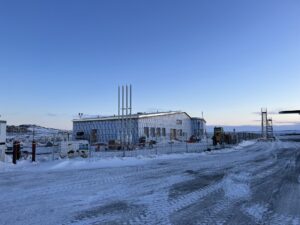
- Thawing permafrost in northern/remote communities destabilising buried pipelines, reservoirs and foundations.
The cost of inaction
Failure to adapt means higher risks of downtime, diminished service, higher maintenance and replacement costs, and reputational or regulatory consequences. The economic analysis in Canada shows that every dollar invested in adaptation today can yield $11–$15 in benefits down the line. In plain terms: investing small now avoids large repair bills later.
Four‑stage roadmap to future‑proof water infrastructure
To build infrastructure that withstands future climate stresses, follow a four‑stage roadmap: Assess, Plan, Design & Build, Operate & Adapt.
1. Assess: Risk & asset review
Start by auditing your existing systems: pipelines, reservoirs, pump stations, treatment plants, remote sites. Map the assets against:
- Current condition (age, material, redundancy)
- Location & exposure (flood zones, permafrost, sea‑level zones)
- Service criticality (community supply, wastewater discharge, industrial process)
- Climate projection data for the region (e.g., precipitation intensity, drought frequency, freeze/thaw cycles)
Use frameworks which integrate both hazard (climate‑driven) and vulnerability (asset or service‑driven) components. Asset‑management systems can help prioritise which assets need resiliency upgrades first.
2. Plan: Strategy, funding & design‑intent
With the risk and asset data in hand, craft a resiliency plan that:
- Identifies vulnerability hotspots (e.g., aging lift station in flood plain; exposed reservoir in permafrost region)
- Sets resilience targets: e.g., “must operate under 1 in 100‑year flood event,” “must maintain service during 7‑day grid outage,” “must resist pipe movement from thawing permafrost.”
- Allocates budget and defines funding mechanisms: many municipalities can access adaptation funds or green infrastructure bonds.
- Defines design intent: not just “replace like for like,” but upgrade to withstand future conditions. For example: upgrading to higher capacity drainage to handle increased stormwater flows, or specifying pipe bedding tolerant of frost heave.
3. Design & Build: Resilient specification
At this stage, leverage the full capabilities of a design‑build contractor (such as Industra) to integrate resilience into every step.
Key design & build considerations include:
- Redundancy and modularity: Avoid single‑point failures. Design pump stations with backup units, redundant power feeds, and modular treatment skids that can be swapped out.
- Flexible design loads: Specify infrastructure to handle loads beyond historical norms. For example, design stormwater systems for higher return‑period events, or reservoirs for higher inflows.
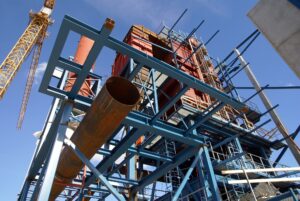
- Durable materials and construction methods: Use materials resistant to corrosion, freeze/thaw, chemical attack, and high‑flow events. Consider precast units, high‑performance concrete, protective coatings. Research shows that advanced materials and retrofits can significantly extend lifespan of structures intended to last 200+ years.
- Elevation and location: In flood‑ or surge‑prone areas, elevate sensitive equipment, avoid low zones, locate backup generators above expected high‑water marks.
- Nature‑based and hybrid solutions: Integrate bioswales, retention ponds, wetlands to buffer stormwater, recharge groundwater and reduce load on “grey” systems. The IISD report shows these provide multiple co‑benefits.
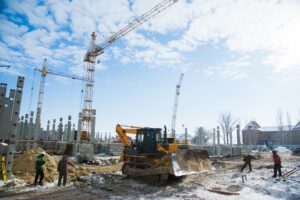
- Remote logistics and challenging environments: For northern, First Nations or remote sites, include logistics planning, modularised construction, access planning (e.g., ice roads, barges). This aligns with the services Industra offers in remote and complex sites.
- Commissioning and testing under future scenarios: Simulate extreme conditions (power outage, high inflow, low supply) to validate resilience design before turnover.
4. Operate & Adapt: Lifecycle management
Once built, infrastructure must be managed with resilience in mind:
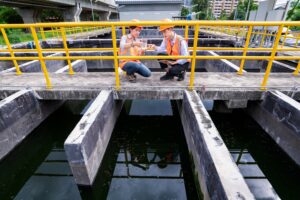
- Monitoring & condition‑based maintenance: Use sensors, SCADA and condition data to detect issues early (e.g., pipe movement, vibration, chemical concentrations).
- Climate‐informed asset renewal: Replace assets not just because of age, but due to vulnerability to emerging climate stresses.
- Flexible operations: For example, during drought operate alternative water sources; during floods divert stormwater or isolate vulnerable zones.
- Continuous review of climate data: Update design standards as more data becomes available. Future‑proofing is an evolving strategy.
- Emergency and continuity planning: Develop and test business‑continuity plans for extreme events: power grid failure, supply disruptions, intense rainfall, contamination events.
- Stakeholder communication and training: Ensure operators understand new systems, new monitoring protocols and how to respond in extreme events.
Four key resilience themes for water infrastructure
Supply‑side resilience
Ensuring supply of clean water even under drought, contamination or source change.
- Alternative or multiple sources: Wells, surface supply, treated reuse, inter‑ties with neighbouring systems.
- Storage and buffering: Larger or multiple reservoirs to hold back stormwater or drought reserves.
- Water‑reuse and circular systems: Grey‑water reuse, treated effluent reuse for non‑potable uses. This reduces load and provides redundancy.
- Protect intake structures: From sedimentation, algal blooms and changing water quality due to drought or warming is critical in design.
Conveyance & treatment resilience
Pipes, pump stations, treatment plants must handle more extreme flows, higher variability and less margin for failure.
- Design for higher capacity: Pipe and channel sizes sized for increased peak flows; pump stations with higher head or redundancy.
- Flood‑proofing: Lift stations located above base flood levels, access roads designed for inundation.
- Energy resilience: Backup generators, alternative power (solar, microgrids) for treatment plants in remote locations.
- Adaptive treatment trains: Processes that can handle variable raw water quality (higher turbidity, warmer temps) or variable flow rates.
- Resilient materials and construction quality: For example, selecting materials that resist frequent freeze/thaw, corrosion from high chloride intrusion (coastal zones) or variable loads.
- Modular construction: Prefabricated or modular components (skids) allow quicker replacements or upgrades, something a self‑perform contractor with modular capabilities (like Industra) can deliver.
Stormwater and wastewater resilience
Often the most vulnerable to climate shifts: increased rainfall events, infiltration issues, sea‑level intrusion, combined sewage overflow.
- Increased capacity and flexibility: Storage ponds, detention basins, upgraded lift stations, variable speed pumps.
- Green infrastructure: Permeable pavements, bioswales, urban wetlands to reduce peak flows into collection systems.
- Rehabilitation of aging sewers: Pipe bursting rather than replacement may allow upsizing while minimising disruption.
- Sea‑level and tidal protection: Coastal communities need backflow preventers, gates, elevated structures, corrosion‑resistant materials.
- Combined systems de‑linking: Where combined storm/wastewater systems exist, separating flows improves resilience and reduces overflow risk.
Remote, indigenous and cold‑climate sites
These pose unique challenges: limited access, permafrost, logistics, small communities, higher cost impacts of downtime.
- Modular prefabrication: Transport modules by ice road, barge or air. Reduces onsite labour, weather exposure and schedule risk.
- Permafrost‑aware design: Foundations and buried pipelines must accommodate thaw settlement. Design for freeze/thaw cycles and variable ground movement.
- Logistics planning: Particularly for northern communities facing short construction seasons and limited supply chain.
- Community partnership and training: Building local capacity ensures long‑term operation and maintenance.
- Redundancy and backup systems: Because of remoteness, downtime is more severe. Backup power, spare parts, alternative supply are essential.
Practical actions for owners and municipalities
Here are key actions municipal owners, utility managers and industrial clients should prioritise:
• Conduct a climate‑risk audit
Start with mapping your infrastructure against future climate scenarios. Use tools and guidance like those from the NRC/Infrastructure Canada.
• Prioritise critical assets
Not all infrastructure is equal. Ranking assets by service importance, consequence of failure, vulnerability and replacement cost helps optimise investment.
• Design with future‑proofing standards
Avoid “build to old weather norms”. Specify higher performance: e.g., pipelines to resist higher temperatures, flooding and corrosion; reservoir access roads above flood levels; treatment plants with redundant power.
• Adopt a multi‑trade, self‑perform approach
Selecting a contractor that can seamlessly handle engineering, fabrication, construction and commissioning under one delivery model reduces risk, improves accountability and speeds schedule, especially critical when upgrading live systems.
• Incorporate nature‑based solutions
Where feasible, integrate green infrastructure (wetlands, bioswales, retention ponds). These reduce loads on systems, buffer water flows and deliver additional benefits (biodiversity, carbon sequestration).
• Embrace phased and modular upgrades
Upgrade in phases, use modular elements to reduce shutdowns and accelerate installation, especially for critical systems. Pre‑fabrication offsite reduces weather impact, schedule risk, labour cost.
• Embed monitoring and adaptive operations
Install telemetry, sensors, condition‑monitoring. Establish triggers for action based on changing conditions (for example when stream temperatures exceed thresholds for intake structures). Build in flexibility to alter operations as conditions shift.
• Develop continuity and emergency plans
Ensure you have backup power, alternative supply, isolation capabilities, emergency repair plans. For remote sites, this is vital.
• Update policy, budget and governance
Future‑proofing requires governance to support it: long‑term funding models (not just reactive repair), updated design criteria, asset‑management focus on resilience.
• Engage stakeholders and communities
Ensure community‑owned and operated systems (especially First Nations) are included from early planning. Integrating Indigenous knowledge and community priorities improves resilience and relevance.
Why choosing the right partner matters
Your choice of contractor has a significant impact on achieving resilience in your water infrastructure.
- Single source accountability: When engineering, procurement, construction and commissioning are bundled under one contract, coordination improves, schedule risk drops and clarity on responsibility rises. Industra’s model emphasises this (see homepage).
- In‑house multi‑trade capability: Minimising subcontractor hand‑offs reduces coordination risks and improves quality control.
- Experience in remote and complex environments: Projects delivered by Industra in remote northern communities, First Nations sites and challenging logistics show capability in exactly the environments where resilience is most needed. (See our Projects page for examples)
- Focus on quality and safety: Resilient infrastructure must also stand the test of time, demands robust quality management.
- Design‑build capability: Being both planner and builder allows for best‑value design decisions that consider long‑term lifecycle costs, not just upfront price.
Addressing budget and procurement realities
One of the barriers to resilience is perceived cost upfront. But the value of resilience (avoided repair costs, service disruption, liability, community impact) is high.
Procurement tips:
- Use performance‑based contracts: specify outcomes (e.g., asset must operate through 1‑in‑100‑year storm) rather than prescriptive design.
- Consider whole‑life cost modelling: evaluate not just capital cost but operation, maintenance, risk of failure, replacement.
- Engage design‑build delivery: enables single accountability and faster delivery.
- Seek grants and adaptation funds: various federal and provincial programs assist municipalities to upgrade infrastructure for resilience.
- Prioritise key assets: focus budget where service disruption is highest, or asset failure consequence greatest.
Looking ahead: Emerging trends and technologies
- Smart infrastructure & IoT: Sensors, AI and real‑time data allow prediction of failure, monitoring of key parameters, adaptive operations.
- Digital twins & simulation: Asset owners can simulate climate impact, system response, downtime scenarios and optimise investment.
- Nature‑based and hybrid systems: As reviewed by IISD, the integration of natural and built infrastructure provides co‑benefits and improves resilience.
- Materials innovations: High‑performance concrete, corrosion‑resistant alloys, modular prefabrication reduce maintenance and increase lifespan.
- Financing models: Green bonds and resilience bonds are becoming more common for water infrastructure upgrades.
Conclusion: Resilience is the new normal
Building water infrastructure for the future is essential for communities, industries and First Nations. The stakes are high: aging systems, changing climate, financial pressure and service expectations all converge. Yet, with a structured approach, assessing risks, planning strategically, designing for future conditions, operating adaptively, and by choosing the right partner, organisations can deliver water systems that stand up to whatever the future brings.
At Industra Construction Corp., we understand the unique demands of water and wastewater infrastructure across industrial, Indigenous, municipal and institutional markets. From remote northern communities to major municipal systems, our in‑house engineering, field teams and multi‑trade capabilities allow us to deliver resilient solutions that meet the demands of today and tomorrow.
If you’d like to explore how we can help future‑proof your next water infrastructure project, connect with us here.